Last Updated on 14 August 2026 by J. Horsewood
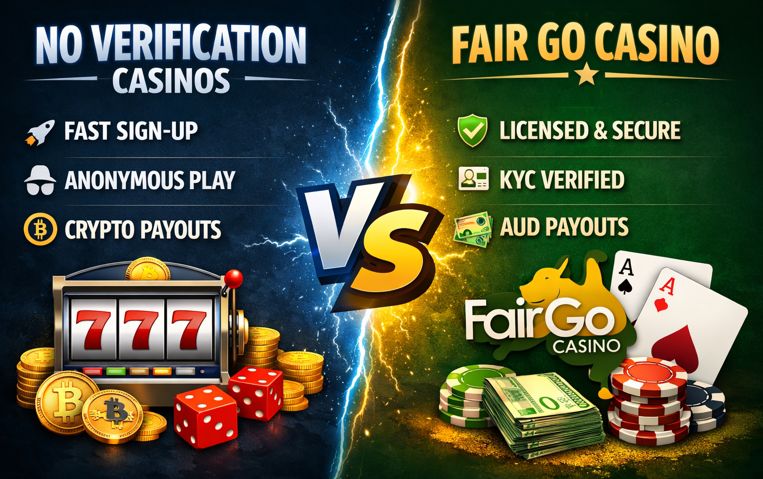
The online casino landscape in Australia has become a complex mix of regulated domestic options, offshore operators and newer business models that promise speed, privacy and convenience. Two distinct categories stand out: no-verification (no-KYC) casinos, which advertise minimal identity checks and fast withdrawals, and established, licensed platforms such as Fair Go Casino, which follow more traditional Know-Your-Customer (KYC) procedures. This review compares both approaches across safety, legality, game selection, payments, user experience and long-term suitability for Australian players — and gives practical advice so you can pick what fits your priorities.
Quick summary — what you’ll learn
-
What “no-verification” casinos actually mean in practice
-
How Fair Go operates and why it’s considered a mainstream option
-
Differences in legality, KYC and anti-money-laundering (AML) expectations in Australia
-
Pros and cons for players who value speed vs players who value protection
-
Practical checklists for choosing a safe casino (no-KYC or licensed)
-
Recommendations and final verdict for Australian users
What are “no-verification” casinos?
“No-verification” or “no-KYC” casinos market themselves on minimal onboarding friction: quick registration, instant deposits and withdrawals (often via crypto or e-wallets), and delayed or limited document checks. In practice there are different flavours:
-
True no-KYC (rare): the site never asks for identity documents — usually tiny, offshore operations with low limits.
-
Soft KYC: the casino lets you play and sometimes withdraw small amounts before requesting documents for larger payouts.
-
Crypto-first casinos: rely on cryptocurrency deposits and withdrawals to reduce the need for standard banking KYC, at least initially.
These operators appeal to players who prioritise speed and privacy. But the trade-off is that no-KYC models may apply low withdrawal caps, require additional checks for larger wins, or operate in regulatory grey zones. Industry trends in Australia and globally are pushing stronger KYC enforcement, which means the no-KYC promise is progressively harder to sustain at scale.
Who is Fair Go Casino?
Fair Go Casino is a long-standing brand that targets Australian and New Zealand markets. It positions itself as a friendly, regionally focused operator offering pokies (slots), table games and a straightforward loyalty programme. Fair Go emphasises familiar payment rails, localised customer service and compliance with the provider’s licensing and fair-play obligations. Independent review sites report generally positive user feedback around fairness and payout reliability, though experiences can vary and some complaints exist — as with any established operator.
Legal & regulatory context (why KYC matters in Australia)
Recent regulatory developments in Australia have made customer identification more central to online gambling. AUSTRAC (Australia’s anti-money-laundering and counter-terrorism financing regulator) updated requirements for online gambling service providers: from 29 September 2024, designated online gambling services must complete an applicable customer identification procedure (ACIP) before creating accounts or providing certain services. In short: regulatory pressure is real and growing, and compliant operators must implement robust KYC processes. That has direct consequences for no-verification operators serving Australian customers.
What this means practically: while Australian players can still access offshore casinos that accept them, local compliance expectations (and payment-partner policies) increase the likelihood that any operator processing larger sums will request ID at some point. Expect low-limit, no-KYC play to remain possible in pockets — but large or repeated withdrawals will often trigger verification.
Safety & fairness
Safety and fairness are the first line of concern for any player.
No-verification casinos
-
Strengths: Fast onboarding and withdrawals (when limits are low); privacy for players who prefer not to upload documents; crypto options can be frictionless.
-
Weaknesses: Higher risk of unlicensed operators, fewer consumer protections, less transparent auditing and a greater chance of dispute complexity if something goes wrong. Large payouts are more likely to be delayed or rejected if KYC is required later.
Fair Go Casino
-
Strengths: Licensed operation, audited RNG games, published RTPs, and clearly defined T&Cs. Structured dispute channels make it easier to resolve payment or fairness issues.
-
Weaknesses: Standard KYC can be cumbersome for some players; verification delays sometimes slow down first withdrawals.
If your top priority is trustworthy, transparent play (and you want the security of a regulated operator), Fair Go or similar licensed casinos are generally safer than no-KYC options. If you trade privacy or speed for higher risk, no-verification casinos can serve a short-term niche — but only with careful vetting.
Payments, withdrawals and speed
Payment experience is where the contrast is most visible.
No-verification casinos
-
Tend to rely on cryptocurrencies, some e-wallets and instant bank rails (where technically possible).
-
Often advertise “instant withdrawals” — but these usually have caps (for example AUD 200–1,000) before KYC is required.
-
Beware of hidden fees or limits that become visible only at withdrawal time.
Fair Go Casino
-
Supports usual payment rails for Australian players (card, bank transfer, e-wallets).
-
Withdrawals generally follow typical processing times (24–72 hours for processing; longer for bank transfers).
-
Withdrawals over a certain threshold trigger KYC (as required by the operator and regulation).
If speed is essential, pick a transparent operator with clear published limits. If you plan to cash out large amounts, be prepared to complete full verification regardless of the casino’s marketing.
Bonuses, wagering and T&Cs
Bonuses are another area where the models diverge.
-
No-KYC casinos may offer attractive no-deposit perks or low-barrier welcome offers, but wagering requirements, max cashout caps and game contribution rules can make real cash extraction difficult.
-
Licensed casinos like Fair Go often have regulated, transparent bonus structures; wagering requirements can still be high, but T&Cs are usually easier to interpret and apply uniformly.
Always read the bonus terms before claiming: look for wagering multipliers, eligible games, max cashout and expiry periods. No-KYC operators sometimes attach smaller print that effectively limits cashability.
Game library and software providers
Game quality is mostly independent of KYC policy — but provider selection can indicate credibility.
-
Fair Go typically partners with established studios for pokies and RNG games, meaning audited fairness and familiar titles.
-
No-verification casinos vary widely: some aggregate reputable software and are indistinguishable in play quality, while others rely on less known studios.
If you want top studios, live dealers and proven RTPs, prefer operators that disclose their software partners and independent audits.
Customer support and dispute resolution
A quick, competent support team matters more than marketing slogans.
-
No-KYC casinos: support responsiveness varies. Some have solid live chat but limited escalation options if the operator is offshore or unlicensed.
-
Fair Go: usually offers reliable support and formal complaint channels governed by the operator’s license conditions.
When choosing between speed and recourse, remember that rapid onboarding is worthless if you can’t resolve a payout dispute.
Responsible gambling and player protections
KYC isn’t only about AML — it’s also about player protection.
-
Fair Go and licensed platforms typically provide responsible gambling features (deposit limits, reality checks, self-exclusion) and proactive monitoring for risky patterns.
-
No-verification casinos may offer fewer or less rigorous RG tools. Without identity verification, enforcement of limits or self-exclusion across accounts is harder.
If you value strong player protection and tools that actually work, licensed operators are better equipped to provide them.
Practical scenarios — which option fits you?
-
You want to try an overseas site quickly, with low stakes and no paperwork: a reputable no-KYC casino (prefer those with positive reputations and transparent policies) can work for casual testing. Be prepared for withdrawal caps and potential document requests later.
-
You plan to play regularly, deposit larger sums or value dispute resolution: choose a licensed operator such as Fair Go. Expect standard KYC but enjoy stronger consumer protections and transparent T&Cs.
-
You prioritise privacy and use crypto: pick a crypto-friendly casino with clear, enforced limits and an established reputation. Avoid anonymous, brand-new sites with no track record.
-
You want regulated play with local orientation (AUD wallets, local support): Fair Go and similar regional casinos are preferable.
Red flags to watch out for (no matter the choice)
-
No clear license or regulator listed
-
Vague or missing withdrawal rules, or very low max cashout for bonuses
-
No public information about software providers or audits
-
Complaints about withheld winnings with no clear escalation path
-
Pressure to deposit through unconventional or opaque payment channels
If you see any of these signs, step back and validate the operator via independent review sites or community forums.
Checklist: choosing safely (quick guide)
-
License check: Does the site display a verifiable gambling licence?
-
Payment transparency: Are deposit/withdrawal methods and limits clearly published?
-
KYC policy clarity: Is the KYC process explained and are limits stated?
-
Provider list: Are reputable game studios named?
-
Support & fairness: Is there live chat and are audit statements available?
-
Responsible gaming: Does the operator offer RG tools and guidance?
Use this checklist for both no-KYC and licensed casinos. It helps separate genuine convenience-focused providers from risky operators.
How regulation is likely to affect no-KYC models
Australian AML/CTF enforcement and international banking policies make long-term viability for no-KYC casinos challenging. Payment partners increasingly require ID checks to prevent fraud and money laundering, while regulators push for stronger consumer protection. As a result, many no-KYC sites may shift to soft-KYC models (allowing small play but requiring documents for larger payouts) or limit Australian access to avoid compliance headaches. This trend means that the “no-verification” advantage will likely shrink over time.
Final verdict — which is right for you?
-
Choose no-verification casinos if: you want fast, low-risk exploration, value anonymity for small stakes, and accept the risk of limited protections and possible verification gates later. Use only well-reviewed, established no-KYC operators and stick to small bankrolls.
-
Choose Fair Go (or similar licensed casinos) if: you prioritise security, transparent rules, stronger dispute resolution and robust RG tools. Expect verification, but benefit from predictable withdrawals and consumer protections.
Practical next steps (what to do now)
-
Decide your priorities: privacy & speed vs safety & protection.
-
Run the checklist above on any casino you consider.
-
Start small: deposit a modest amount to test deposits, games and withdrawals.
-
Read the withdrawal/KYC policy before you play — don’t assume marketing claims of “no KYC” will hold for large payouts.
-
Keep evidence: save screenshots and emails until withdrawals clear — useful if disputes arise.
Closing thoughts
The choice between no-verification casinos and licensed operators like Fair Go comes down to risk appetite and playing intent. In 2026, the regulatory environment in Australia strongly favours verified, compliant operations and financial partners who will not tolerate sustained anonymity for large transactions. No-KYC offers convenience today, but licensed casinos provide the stability and protections that matter for longer-term play and larger stakes. Use both models intelligently: one for quick testing and entertainment, the other for dependable, regulated wagering.